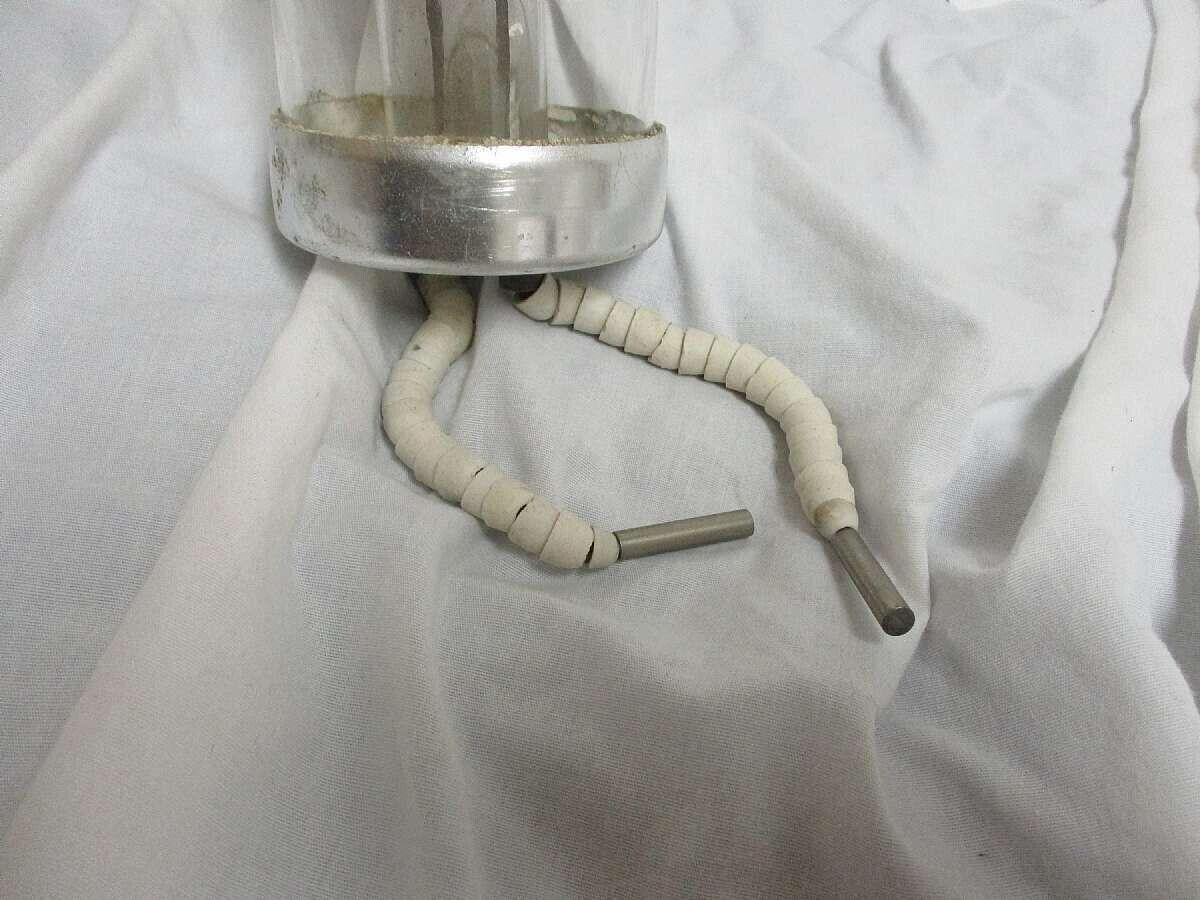
1940's Rare X-ray Vacuum Tube Museum Quality BR-237 VIII-60 Rare
1940's Rare X-ray Vacuum Tube Museum Quality BR-237 VIII-60 Rare
Couldn't load pickup availability
Museum Quality
The technical specifications for the BR-237-III-60 are defined by its electrical capacity, thermal management, and physical focal spot dimensions. The "60" in the designation typically refers to the maximum peak kilovoltage () or a specific power rating in kilowatts () depending on the manufacturer's nomenclature, though in this specific series, it often denotes a maximum operating voltage of 150 kV and a focal spot size of 0.6 mm / 1.2 mm.
Electrical and Thermal Specifications
The tube operates by accelerating electrons from a heated filament (cathode) toward a tungsten-rhenium alloy target (anode). The primary specifications include:
- Maximum Tube Voltage: 150 kV, allowing for deep penetration in dense tissue or industrial materials.
- Focal Spot Sizes: This is a dual-focus tube with a small focal spot of 0.6 mm (for high-resolution imaging) and a large focal spot of 1.2 mm (for high-power exposures).
- Anode Heat Storage Capacity: Approximately 300,000 to 400,000 Heat Units (HU), which determines how many consecutive exposures can be made before the tube requires a cooling interval.
- Anode Rotation Speed: Standard speed of 3,000 to 3,600 RPM at 60 Hz, or high-speed rotation up to 10,000 RPM for increased power loading.
Physical Construction
The BR-237-III-60 features a glass or ceramic envelope to maintain a high vacuum, which is essential to prevent ionization of residual gas that would interfere with the electron stream. The anode target angle is typically between 12° and 15°, a design choice that balances the "line-focus principle" to provide a small effective focal spot while maintaining a large actual area for heat dissipation. The tube is usually housed in a lead-lined protective casing filled with dielectric oil, which serves both as an electrical insulator and a cooling medium to transfer heat away from the vacuum insert.
Share